By Sheila Rahman January 06, 2009 Categories: CyberspotIts easy enough to say that life’s out there, waiting to be conquered. Today, we feature three of our Cybercitizens who were highlighted in this page the past year – all of whom have the common human thread of reaching out – similar goals but with different measures of “success”.
Craig and Jennifer Alsup from the United States are on a round-theworld adventure.
Desmond Jerukan would like development to come to his longhouse clan in the interior of Sarawak. And Peter Tan would love to catch a bus.
“2008 has been a real interesting year for advocates like me who use blogs to reach out to a wider audience and garner support for our cause,” says Tan. “Information in our blogs is available 24/7 to anyone who has an Internet connection anywhere in the world.
“Compare this to standing on a soapbox and shouting ourselves hoarse to only a handful of people. I truly believe that I have been able to educate more people on disability issues through my blog than if I were to do it face to face…”
Peter Tan
The Digital Awakening Living One Day At A Time
http://www.petertan.com/blog
I Hope that 2009 will be a better year for disabled people in Malaysia who have been marginalised for so many decades.
We are beginning to see some signs of the government paying more attention to the problems that we face in society.
Still, whatever being done is on piecemeal basis and is too little to be effective in improving the life of disabled people in general.
I would like to see improvement in the built environment and public transportation. These are the two vital links that will allow disabled people to access other services and facilities, such as education and employment, and to lead an active social life.
I also hope that people will not abuse available accessible facilities such as toilets and parking spaces. These facilities are far and few between and are there for a specific purpose. Without them, disabled people will have great difficulty to be out and about.
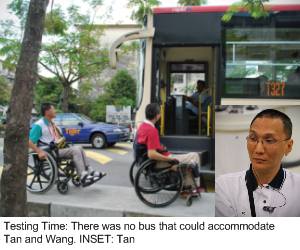
I am attaching a photo taken when I tried to board a RapidKL bus in Pandan Perdana with my friend Wang Siew Ming. This problem is faced by all wheelchair users in Malaysia who are unable to use public transport to move around. If we do not have our own transport, we will be stuck at home.
(Ed’s note: Here, we wrote back to Tan to ask if he caught his bus.)
We did not manage to get into any of the buses. The feeder buses serving housing estates have steps and it is impossible for wheelchair users to board. There are buses with ramps but these are serving trunk routes only. At the moment, these buses do not allow wheelchair users to board because there is a lack of suitable bus stops. Even if we can board these buses, there is a lack of connectivity from the housing estates to the bus hubs where we can catch the buses with ramps.
To exacerbate the situation, wheelchair users cannot get to bus stops because most pedestrian walkways do not have ramps but curbs that are six to 10 inches in height. This prevents wheelchair users from getting onto the walkways. We have to go onto the roads to move from one place to another. This puts us at risk of being hit by cars and other vehicles.
It is important that there is no break in the circle of mobility for wheelchair users from the point of origin to their final destination and back. Any break in between will cause problems.
In Malaysia, there are many breaks in between, which make it impossible for us to move around using public transport.
This is in stark contrast to Tokyo, which is a paradise for wheelchair users. The public transport system and the built environment are fully accessible. The two weeks that I was there, I had no problems travelling by train, monorail or bus. They have portable ramps in all train stations where there is a difference in height between the platform and train and stations masters are always ready to assist wheelchair users when requested.
I just cannot understand why, in our Malaysia Boleh spirit, disabled people still encounter so many barriers in society when we already have the capability to build some of the tallest buildings and longest bridges in the world. We even have an angkasawan who has travelled to the International Space Station some 300km in outer space – but many disabled people are still unable to get out from their homes safely and conveniently.
You may want to have a look at “Eleanor Freewheeling” (ewheeling.over-blog.com), who is a Malaysian and fellow disability-rights advocate currently residing in the UK.
In her latest entry, she talks about wanting to come back to Malaysia but is unable to because the built environment is full of barriers and the lack of support system for her to move around conveniently and live independently.
Although Malaysia has just signed the United Nations Convention on the Rights of Persons with Disabilities and at the same time, with the Persons with Disabilities Act 2008 coming into force last year, rightsbased advocates still have a daunting task ahead. We are at a loss as to how society, and especially the government, can continue to turn a deaf ear to our pleas for better living conditions again and again.
I truly hope 2009 will be a turning point for the rights of disabled people to be fully recognised and the government coming out with a comprehensive policy and action plan to uplift us from the deplorable situation we are in now.
Desmond Jerukan
Nadai Nama Nama (From nothing…)
http://nadai.name/weblog
The year 2008 was pretty amazing. After Malay Mail highlighted my blog in September, my grandma and friends in Sarawak began to realise the wonders of Cyberspace.
How did a little known blogger’s activities make it to a newspaper in Kuala Lumpur? Grandma was also amazed at the speed her picture came out in the papers. But it’s not easy to explain to our folk as the Internet structure has not even reached the rural corners of our longhouse.
So we decided to make known our own longhouse in this little village of Nanga Beguang Song on the Island of Borneo through the Internet (www.beguang.com), hoping that people, both local and from abroad, will come and visit.
With the economic gloom looming in 2009, it could very well mean the pace of development is affected.
The daunting task is to prepare some “cushioning” for the rural folk who would not be able to understand why the value of the money is shrinking.
The longhouse is also known as Rumah Richard Nujong (longhouses are always named after the village head). My brother and I, who are the webmasters, are trying our very best to get its proposed Homestay efforts on track. Its quite challenging in a way as Rumah Richard is an example of a longhouse that receives no steady electricity or treated water supply, and does not have any road leading to it. The folk there (who have formed a committee!) however have maintained its cleanliness and pristine beauty. The main transport is the perahu or express boat, which is the mode of transport for rural folk with no road access.
My hope is to see basic infostructure (ICT, Internet – broadband & wireless) and infrastructure (roads, bridges, water and electricity) reaching the interiors of Sarawak. As for Internet broadband development, I am hoping for faster and reliable connectivity to enable our Cyberpreneurs here to explore the possibilities of Internet Business to supplement dwindling incomes.
Craig & Jennifer Alsup
A RTW (round-the-world) travel log
Website: Alsupsworldtravels.com
We celebrated the New Year in Egypt’s Siwa Oasis. It’s a little donkey cart town in the middle of the Sahara Desert, near the Libyan border. Nice break from all the excitement of travelling in bigger cities.
It has been amazing letting the world (i.e. our friends, family, and a few loyal followers) in on our roundthe- world journey. We have enjoyed every minute of being able to easily convey our thoughts, ideas, and goals in almost real-time. Without our site, it would be so much more difficult to let the people at home in on our lives over here.
In 2009, we hope for continued health and happiness for ourselves along this trip, our families and friends at home, and all of the amazing people that we have met along our way (like our “son” we have decided to sponsor from an orphanage called the Rainbow Children’s Home in Nepal).
We have followed a few sites during our trip and prior to it – we enjoyed most the blogs of fellow travellers Brooke vs the World (usversustheworld.com/brookevstheworld) and of couple Christian and Casey (www.followingthedream.com) We wish everyone a happy year ahead and going forward.
Category: Accessible Public Transport
Penang to make public transport disabled-friendly by 2010: The Star – December 11, 2008
Published: Thursday December 11, 2008 MYT 1:20:00 PM
Penang to make public transport disabled-friendly by 2010GEORGE TOWN: Penang will be the first Malaysian state to conduct a full audit of its public transport facilities while it develops a comprehensive blueprint to improve the access and mobility of people with disabilities by 2010.
The initiative to boost the economic and social independence of those with disabilities, will be done through a two-year pilot project by the state’s Economic Planning Unit (UPEN) and the United Nations Development Programme (UNPD) to study how to create a barrier free public transportation in Penang.
UNPD Assistant Resident Representative James George Chacko said the “Transport for Persons with Disabilities – Support of the Development of Accessible Transport in Penang” and its access audit on public buses, taxis, trains, ferries and airplanes as well as other infrastructures would lead to the development of a holistic transport improvement strategy that would in turn offer a framework for raising awareness levels in the general public.
“The audit will also look into pick-up points, road pavements and pathways emphasising on inter-connectivity. The findings of this audit will form the basis to develop an accessible public transport improvement master plan.
“The other initiatives to be undertaken in the coming months will include a demand responsive door-to-door transport service in Penang island; capacity building for disabled people in accessing public transportation; disability equality training for front line transport operators; training on access building requirements and universal design for contractors, architects and civil servants; designing a barrier-free bus stop model; and an awareness campaign,” he said at the launching ceremony of the UNPD-UPEN project at Dorsett Penang Hotel on Thursday.
Chacko also said the project was supported by the Women, Family and Community Development Ministry, and UNPD was confident with the project’s strong rationality, it would receive the necessary financial backing of the Federal Government.
“The project seeks to develop a ‘best practice’ model that we hope can be replicated nationwide,” he added.
State Local Government, Traffic Management and Environment Committee chairman Chow Kon Yeow, who launched the project, said the state government was also studying the possibility of drawing up a transport master plan and forming a state transport commission to serve as a one-stop agency responsible for planning, implementation and management if all transport issues in Penang.
“The necessary documents are currently being prepared for submission to the state executive council.
“We hope they will be ready by the end of the month or early next month before we start work on formulating the master plan, which we estimate will take one or two years to draw up and implemented,” he said. – Bernama
Getting in and out of buses a breeze for the disabled: The Star Metro – November 13, 2008
The Star Metro
Thursday November 13, 2008
Getting in and out of buses a breeze for the disabled
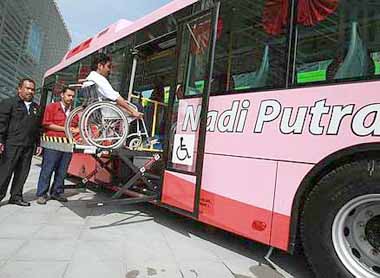
Story and photos by CHARLES FERNANDEZFIFTEEN new Nadi Putra buses fitted with special lifters for the disabled or orang kurang upaya (OKU) were recently added to the current fleet of 55 buses servicing Putrajaya.
The newly-introduced buses will display the OKU sticker for easy identification and they come in four colours.
Federal Territories Minister Datuk Seri Zulhasnan Rafique received the buses on behalf of the Putrajaya Corporation (PJC), witnessed by PJC president Tan Sri Samsuddin Osman, FT Deputy Minister Datuk M. Saravanan and FT Ministry secretary-general Datuk Ahmad Phesal Talib.
Boost for disabled: A passenger is being lifted onto the bus.The lifter is placed at the back door and is controlled by the driver and the whole proceeding is viewed via a CCTV network fitted in the bus.
“Before the delivery of the new buses, Nadi Putra had 55 buses with 51 powered by NGV and four diesel-driven ones. Since June 2006 we use NGV for all buses operating here,’’ said Zulhasnan.
He said the 15 buses would service new housing areas in Precincts 5, 6, 15 and 18 to complement the current fleet of buses running the routes in Precincts 9 and 14.
“However, the numbers are still not enough to satisfy the needs of the residents and working community here who are encouraged to use the ‘Park and Ride’ system already in place,’’ added Zulhasnan.
As for long-term plans, Zulhasnan said the government had approved RM70mil for the purchase of another 104 buses which would be introduced in stages within the next two years.
When asked if the disabled community could use the services for free, Samsuddin said for the moment it was free.
“The fare is already subsided. It is only 50 sen,’’ he said.
Samsuddin added that the number of passengers using the Nadi Putra services had also increased from 100,000 in May last year to 230,000 until the end of October this year.