petertan.com icon

Archive for the 'AirAsia' Category


Total pages: [6]12345>>Last Page

AirAsia, BEAT And What Disabled People Really Need

Monday, April 14th, 2008

AirAsia has finally launched the ambulift at the KLIA-LCCT after several months delay. The ambulift is to assist disabled people board and disembark from the aircraft. At the same time, the budget airline was reported to have said that another ambulift is based in the Kota Kinabalu International Airport. This is a good move on the airline’s part in moving towards making air travel more accessible for disabled people. For this, I would like to congratulate the Barrier-Free Environment and Accessible Transport Group (BEAT) for being able to convince AirAsia and its chief executive officer Dato’ Tony Fernandez that air travel should not be limited only for people who can walk.

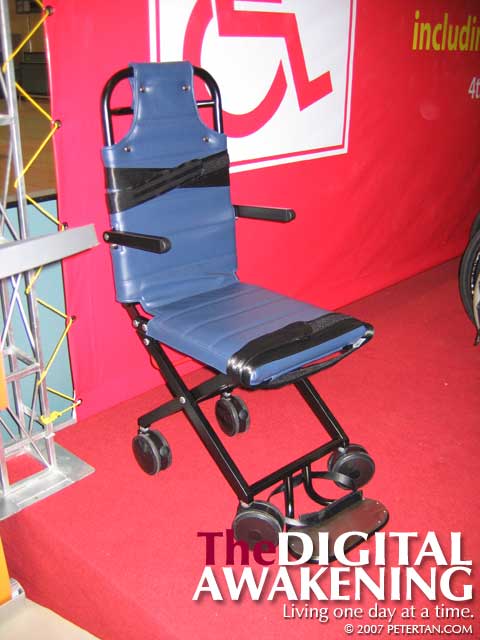
While the ambulifts will ease one of the problems faced by disabled people flying with the airline, the cabin is still generally inaccessible, especially the toilets. No mention was made on whether all the aircrafts are equipped with aisle chairs as promised by Dato’ Fernandez. If not, BEAT must pursue this matter to ensure that disabled people will not face problems when they need to move around in the aircraft or use the toilet. The other matters that need to be looked into are indemnity forms, the RM12 charge for using the wheelchairs at the airport and proper handling of disabled persons and their wheelchairs. I believe some of those issues have been resolved. BEAT and AirAsia should come out and announce it publicly to prevent confusion and inconsistent imposition of policies by the airline’s staff.

Having said that, I would like to remind BEAT, especially Christine Lee and V. Murugeswaran who are leading the group, not to forget the purpose why the group was formed. Its main purpose was to advocate for accessible public transport which has been given scant attention of late. While they openly applaud the launching of the ambulifts, they seemed to have disregarded the fact that disabled people still do not have access to public transport to take them to the airport. What is the point of advocating for accessible air travel when disabled people cannot get to the airport? Not every disabled person can drive, afford to own a car or transfer into taxis.

BEAT should seriously consider reinitiating negotiations with RapidKL and related government ministries to ensure that the 100 RapidKL buses already fitted with ramps allow wheelchair users to use them. It is ironic that these buses with the wheelchair logos affixed to its exterior do not take wheelchair users at the moment because BEAT has refused to endorse the buses due to safety considerations. The ramps and wheelchair locking mechanisms were deemed unsuitable and non-functional. As far as I know, BEAT has not pursued this with RapidKL but prefer to concentrate most of its effort on AirAsia.

Disabled people like everyone else need access to public transport, namely buses and trains, for education, employment, medical appointments, social and religious functions, among others. While I agree that disabled people need to have access to air travel, BEAT should judiciously use its limited resources to advocate for an issue that will benefit the most people, not one that only a handful will be using. In my opinion, there must be a sense of priority and the priority now is public transport and not air travel.

Consider the following facts.
100 out of RapidKL’s 1000 buses are accessible = 10%
2 out of AirAsia’s 55 destinations are accessibe = 3.6%
The mode of transport does disabled people need to use more often

RapidKL bus driver assisting wheelchair user into the bus

While BEAT has been generous with its applause for AirAsia, it has been very critical of RapidKL’s efforts to the extent of refusing to endorse the 100 buses. It simply does not make any sense. We have here 100 buses that will benefit all wheelchair users in the Klang Valley but BEAT prefers to ignore that fact and openly throw its support for AirAsia’s 2 ambulifts. BEAT’s logic in refusing to endorse those buses was because the ramps were too short and may cause wheelchairs to tip backwards. During discussions with RapidKL, the bus operator has informed BEAT that wheelchair users are only allowed to board the buses with the assistance of the bus drivers. That should reduce the risk of wheelchairs tipping backwards.

Disabled person being carried up the plane stairs into AirAsia plane

How dangerous can that be compared to carrying a disabled person up or down the flight of narrow plane stairs? Having been carried up not once but six times up such stairs, twice with Malaysia Airlines in 1999 when it was still flying into Subang International Airport and 4 times with AirAsia in 2007, I can attest to the recurring fear of being dropped or the ground crews slipping on the steps each time I was carried. The AirAsia ground crews, and Malaysia Airlines at that time, were neither properly trained in doing the two-man carry nor observed safety procedures when performing this task. Who will be held responsible should any mishap occur while being carried up or down the stairs?

News report stated that 40 disabled people attended the launching of the ambulift. The leaders of BEAT should ask themselves how many of those 40 disabled people fly frequently and which mode of transport they need most. Were they able to use public transport to get to the airport? If not, why? Bread and butter issues of disabled people should be resolved first before anything else. That should be the priority. When disabled people cannot even get into public buses to move around conveniently around Kuala Lumpur, why is BEAT committing so much of its limited resources into advocating for accessibility in air travel?

BERNAMA
April 12, 2008 16:58 PM

Airasia Provides Ambulift Facility For Disabled Passengers

SEPANG, April 12 (Bernama) — To provide accessibility for disabled passengers, AirAsia Bhd has placed an ambulift at the low cost carrier terminal (LCCT) here and another in Kota Kinabalu.

Group chief executive officer Datuk Tony Fernandes said Saturday the facility will provide better mobility and comfort for the airline’s disabled passengers.

Previously, disabled passengers were physically carried by AirAsia’s ground staff to board the aircraft, Fernandes told reporters after the launch of the facility at the LCCT here.

According to him, installation of the facility at the two airports cost RM1.3 million, including training for the staff.

The airline is discussing with the Kuching Airport authority to place an ambulift there.

It is also looking at placing ambulifts in other airports such as Penang, Jakarta and Bangkok.

Up to four disabled passengers are allowed on a flight, and two of them can be quadriplegics.

AirAsia, said Fernandes, is in talks with Malaysia Airports Holdings Bhd to provide free aerobridge use for disabled passengers at airports that do not have ambulifts.

– BERNAMA

The Star Online
Sunday April 13, 2008
Ambulift launched at LCCT

AirAsia launches ambulift for disabled passengers

SEPANG: AirAsia launched its first ambulift at the Low Cost Carrier Terminal (LCCT) here to allow disabled passengers to board the aircraft instead of being physically carried into the plane by AirAsia workers.

The airline bought two ambulifts, one to be placed at LCCT and another one at Kota Kinabalu airport.

Ambulift is a lift that is attached to the back of a van to lift passengers from the aircraft to the ground so they do not have to use the steps.
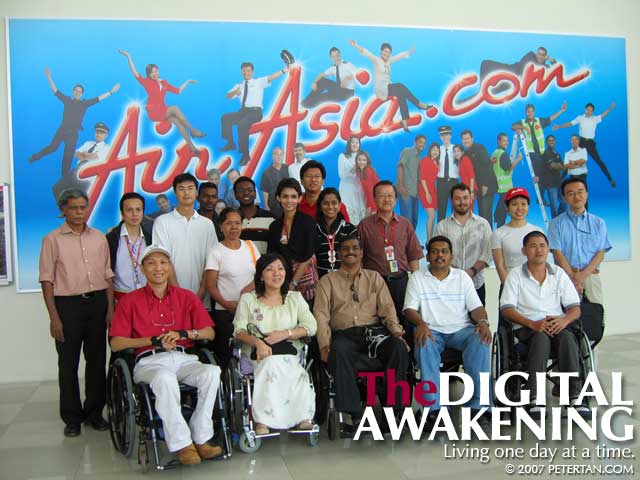
Disabled-friendly move: An AirAsia flight attendant posing with disabled people in front of the new ambulift at the LCCT at the KL International Airport on Saturday.

Nine months ago, members of the Barrier-Free Environment and Accessible Transport Group (BEAT) representing the disabled community gathered at the LCCT to protest the carrier’s “discriminatory” policy and demanded disabled-friendly services by AirAsia.

They asked the airline to provide an ambulift to allow disabled passengers to board the aircraft instead of being physically carried into the plane by AirAsia workers.

Former Transport Minister Datuk Seri Chan Kong Choy then ordered Malaysia Airports Berhad and AirAsia to solve the problem.

AirAsia chief executive officer Datuk Tony Fernandez said providing the ambulift was only one part of their initiatives to be disabled-friendly.

He said they were also in talks with Malaysia Airports to provide free aerobridge usage at airports that do not have ambulifts and give staff hands-on training by engaging those from the disabled community.

“We will also enhance our services and accessibility where possible and we hope to set the example for other LCCTs and airlines to work towards an improved environment for our disabled friends,” he said.

However, he hoped Malaysia Airports would improve airport facilities and provide level walkways and designated car parks.

Fernandez also said that the AirAsia’s A320 aircraft could only take a maximum of four disabled guests per flight and two of the seats could accommodate quadriplegic flyers.

BEAT coordinator Christina Lee welcomed AirAsia’s move to introduce disability equality training for the cabin crew and staff.

“This will give them a better understanding of “disability” issues as well as tips on how to relate to and assist disabled passengers,” she said.

AirAsia’s Press Release:
Greater Comfort and Accessibility for AirAsia Disabled Friends

Tags: ,

AirAsia, Wheelchair Users And Indemnity Form: The Ongoing Saga

Monday, January 7th, 2008

With no satisfactory official response forthcoming from AirAsia regarding the policy of imposing indemnity form on wheelchair users after more than two months, I decided to refer my complaint to the Minister of Transport Dato’ Sri Chan Kong Choy and the Minister of Women, Family and Community Development Dato’ Sri Shahrizat Abdul Jalil.

The complaint was sent via email just now and hardcopies will posted to the respective ministers and three other persons in the carbon copy list, namely Senator Prof Datuk Dr. Ismail Md Salleh, Society of Orthopaedically Handicapped Malaysia President Dr. Tiun Ling Ta and Malaysian Spinal Injuries Association President Dr. Rahim bin Noor. I am a member of both organisations. Not long after the email was sent, Ministry of Transport Secretary General Dato’ Haji Zakaria Hj Bahari forwarded the mail to AirAsia CEO Datuk Tony Fernandez asking him to take action accordingly.

Below is the content of my complaint letter:

4 Januari, 2008

Y.B. Dato’ Sri Chan Kong Choy Melalui emel dan pos
Menteri Pengangkutan
Blok D5, Kompleks D
Pusat Pentadbiran Kerajaan Persekutuan
62616 Putrajaya

Y. B. Dato’ Sri Shahrizat Abdul Jalil Melalui emel dan pos
Menteri Pembangunan Wanita, Keluarga dan Masyarakat
Aras 1-6, Blok E
Kompleks Pejabat Kerajaan Bukit Perdana
Jalan Dato’ Onn
50515 Kuala Lumpur

Dato’ Sri Chan dan Dato’ Sri Shahrizat,

PER: DISKRIMINASI TERDAHAP PENUMPANG YANG MENGGUNA KERUSI RODA OLEH AIRASIA

Saya ingin membuat aduan tentang perkara di atas yang telah berlaku pada diri saya.

1. Pada 30 Oktober 2007, saya bersama isteri saya telah daftar masuk di Lapangan Terbangan Antarabangsa Kota Kinabalu untuk menaiki penerbangan AirAsia AK 5107 ke Kuala Lumpur. Saya adalah pengguna kerusi roda.

2. Seorang pegawai AirAsia meminta saya menandatangani borang lepas tanggungan (Release and Indemnity). Antara fasal yang terkandung di dalam borang itu adalah:
- AirAsia tidak akan bertanggungjawab sekiranya berlaku apa-apa pada diri saya semasa penerbangan.
- Saya bersetuju menanggung segala perbelanjaan AirAsia yang mungkin disebabkan oleh diri saya dalam penerbangan tersebut.
- Saya telah menandatangani borang itu secara sukarela .

3. Saya telah membantah dengan sekerasnya dan meminta perkara ini dirujuk kepada pihak pengurusan AirAsia di Kuala Lumpur sebab perbuatan yang mewajibkan saya menandatangani borang itu adalah diskriminasi terhadap saya sebagai seorang pengguna kerusi roda.

4. Setelah pegawai itu merujuk kepada pengurusnya, saya diberitahu bahawa sekiranya saya tidak menandatangani borang tersebut, saya tidak akan dibenarkan menaiki pesawat. Saya tidak mempunyai pilihan kecuali menandatangani borang tersebut untuk dibenarkan menaiki pesawat kembali ke Kuala Lumpur. Apabila menandatangani borang tersebut, saya juga telah menulis dengan huruf besar yang terang bahawa saya membantah perbuatan tersebut. Salinan borang tersebut dilampirkan.

5. Saya telah memaklumkan kejadian tersebut kepada Datuk Tony Fernandez dan Encik Bo Lingam dari AirAsia melalui emel. Maklumbalas dari kedua-dua mereka sungguh tidak memuaskan. Sehingga kini, selepas dua bulan, pihak AirAsia masih belum memberi penerangan yang munasabah mengenai syarat ini kecuali mengatakan bahawa ia adalah syarat dari syarikat insurans mereka. Alasan ini tidak boleh diterima kerana Malaysia Airlines tidak mengenakan syarat ini keatas pengguna kerusi roda kecuali satu kesilapan di Jepun di mana Profesor Yutaka Takamine diminta mendandatangani surat lepas tanggungan. Malaysia Airlines telah pun meminta maaf kepada Profesor Yutaka seperti yang Dato’ Sri-Dato’ Sri sudah dimaklumkan.

6. Saya telah menghadiri kursus “Independent Living Program for People with Disabilities” di Jepun dan Thailand pada 2006 yang dianjurkan bersama oleh Jabatan Kebajikan Masyarakat Malaysia dan Japan International Cooperation Agency. Dalam penerbangan ke kursus-kursus tersebut dengan Japan Airlines dan Malaysia Airlines, saya tidak diminta untuk menandatangani borang lepas tanggungan. Saya juga telah menghadiri 7th Disabled Peoples’ International World Assembly dan Global Summit on Independent Living di Korea baru-baru ini sebagai speaker untuk kedua-dua perhimpunan tersebut dengan penerbangan Malaysia Airlines dan juga tidak diminta untuk menandatangi borang tersebut.

7. Saya ingin merujuk kepada cadangan daripada 18 pertubuhan OKU yang diserahkan kepada Dato’ Sri Chan pada mesyuarat di Kementerian Pengangkutan pada 12 Mac 2007 di mana kami meminta supaya syarat yang mewajipkan pengguna kerusi roda menandatangani surat lepas tanggunan yang diamalkan oleh syarikat penerbangan dilarang sama sekali. Salinan cadangan tersebut dilampirkan.

8. Syarat yang diskriminasi ini melanggar hak asasi saya. Saya berharap Dato’ Sri Chan dan Dato’ Sri Shahrizat akan mengambil tindakan dengan segera supaya perkara yang sebegini tidak berlaku lagi. Ia juga untuk memelihara hak OKU yang termaktub dalam Rang Undang-Undang Orang Kurang Upaya 2007 dan Konvensyen Mengenai Hak Orang Kurang Upaya (Convention on the Rights of Persons with Disabilities).

Perhatian Dato’ Sri-Dato’ Sri di atas perkara ini amat dihargai.

Sekian, terima kasih.

Related entry:
BEAT’s Recommendation To The Ministry of Transport Malaysia

Tags: , , ,

Widespread Discrimination of Disabled Passengers by Low-Cost Airlines

Thursday, December 20th, 2007

Scott Rains alerted me to the following news report. It seems that the act of discrimination against wheelchair users is not limited to Malaysia’s AirAsia. The Hindustan Times news titled Airline Displays Callousness in December 19 reported that Sanjiv Sachdeva was asked to sign a bond to absolve Jetlite from all responsibilities should anything happen to him in a flight on December 16. Jetlite is an India-based low cost carrier. Sanjiv has filed a complaint with the Directorate General of Aviation and the Commissioner of Diabilities.

In the same newspaper report, another wheelchair user Mahesh Chandrashekar was subjected to similar conditions by Deccan, India’s first low-fare airline. Mahesh was reported to have said that the language used in the indemnity form sounded prejudiced, embarrassing, derogatory and appeared as if a favour has been doled out to a passenger with disability who is travelling on a fully-paid ticket.

Indemnity forms are worded in such a way that the person who signed it absolves the airline from all blame should anything happen. Too bad if that person dies or is injured as a result of flying with the airline. To add insult to injury, if the airline has to incur additional costs because of that person, the said person has to bear all that. Tell me, where is justice in that? Heads I lose. Tails also I lose. Mana boleh? Unbelievable? Go read the indemnity form that Airsia made me sign.

Tags:

Airlines dive in survey of disabled passenger satisfaction: The Sydney Morning Herald - December 17, 2007

Monday, December 17th, 2007

The following news report by The Sydney Morning Herald regarding air travel for disabled people in Australia is equally relevant here in Malaysia in the wake of unfair conditions imposed by AirAsia on disabled people.

Airlines dive in survey of disabled passenger satisfaction

Bonny Symons-Brown
December 17, 2007

PEOPLE with disabilities have significantly more trouble accessing airline services than five years ago, despite the introduction of a national standard to protect them.

The Public Interest Advocacy Centre surveyed 110 people with disabilities, their carers or advocates and found that only 14 had an overall positive experience when dealing with airlines.

Its report concludes that there has been “a systemic failure of airlines to improve access”. It has been submitted to a federal government five-year review of disability standards for accessible public transport.

The standards are a regulatory framework for all modes of public transport but there is no compliance monitoring or licensing requirement for airlines to meet the standards.

Even if the airlines do meet the standards, the report warned, the standards do not adequately protect the human rights of people with disabilities.

The complaints included airline announcements that delays were due to a wheelchair passenger, travel being refused unless the disabled person was accompanied by a carer, and broken wheelchairs due to negligent handling. In one case, a passenger was left on the tarmac with no assistance to the terminal entrance.

The centre’s chief executive officer, Robin Banks, said restrictive airline policies on aids such as wheelchairs or assistance animals and inadequate communication between staff and customers with a disability had lead to negative experiences for many disabled travellers.

“People reported things like they felt humiliated or they felt embarrassed, some of them said they wouldn’t be flying again, and the sense that people were afraid of the experience being repeated,” she said.

“The other really strong and common theme is a sense of frustration and a sense that the person they were dealing with couldn’t resolve, or was unwilling to attempt to resolve, the problem.”

The report, co-ordinated with the NSW Disability Discrimination Legal Centre, calls for an airline-specific code of practice to be developed in consultation with people with disabilities and administered by a relevant federal transport agency; mandatory reporting requirements, with data released annually; training courses in disability management for all airline staff; and an industry-based complaints process.

Ms Banks said that in a country such as Australia, where air travel was an important part of public transport, people with disabilities should not continue to confront accessibility problems.

Tags:

Airlines, Indemnity Forms And Disability Advocates

Tuesday, December 11th, 2007

Is the act of forcing wheelchair users sign indemnity forms before allowing them to board commercial flights a form of discrimination? That depends on who is answering the question. Some may ask why I am harping on this issue again. I am still annoyed, that is why. This entry is also inspired by a news article titled Airlines warned not to bar disabled in The Australian today. The Human Rights and Equal Opportunity Commission, Public Interest Advocacy Centre and disability groups in Australia are pursuing cases against airlines that imposes discriminatory policies against disabled air travellers.

I have flown with Japan Airlines, Malaysia Airlines and AirAsia. AirAsia is the only airlines that compels wheelchair users to sign an indemnity form before allowing them to board the aircraft. I have no complaints whatsoever against Japan Airlines. Their in-flight service was impeccable. I told them that I needed to go to the toilet at a certain time. The cabin crew came with an aisle chair right on the dot and assisted me to the toilet and back. I had several issues with Malaysia Airlines but they responded to my complaints politely when I wrote to them regarding the non-availability of an on-board aisle chair on my flight from Kuala Lumpur to Incheon and back. They even offered me one complimentary return ticket to any destination in Asia to make up for the shortfall in service which I declined.

AirAsia? The reply to the entry that I forwarded to them was disappointing. According to them the indemnity form is a requirement by their insurers and they are working to remove that condition imposed on wheelchair users. It was a premature move on my part to kick up a fuss when the process was still on-going. Nevertheless, I would like to reveal the double-standard that is being practiced. Members of BEAT who fly with AirAsia are encouraged to call up the management to make prior flight arrangements where they may not even be compelled to sign the indemnity form. Wheelchair users who are not part of BEAT and do not have access to AirAsia management do not have that privilege as evident by the other two wheelchair users whom I witnessed signing the forms at Kota Kinabalu. What kind of advocacy is that?

Although I was advised beforehand to make prior arrangements I did not because I wanted to experience for myself the kind of procedures that wheelchair users have to go through. Only then could I discover the kinks in the system. Having experienced it and revealed the bad experience to members of BEAT, I was blamed for causing irreparable damage to the group. I was expected to channel my grievances through selected people who would then create avenues for me to voice out my dissatisfaction. Apparently, the truth had to be filtered to make certain parties look good. See the difference in the RapidKL advocacy where nobody in BEAT reacted to the entries that were critical of the bus operator. That tells a lot, does it not? Harapkan pagar, pagar makan padi. That was why I left.

I shall not say more but allow my blogger friends cum disability advocates from around the world share with you their viewpoints on this issue of wheelchair users being compelled to sign indemnity forms.

My story - AirAsia Still Practices Discrimination Against Disabled People
Dr. Scott Rains - Picking on the Wrong Passenger: AirAsia Gambles on Discrimination
Eleanor Lisney - Air Asia Discrimination against disabled passsengers
Ivan Chew - Case of AirAsia and its provisions for People With Disabilities

Tags: , , , ,


Total pages: [6]12345>>Last Page