December 03, 2006 14:17 PM
Disabled Deprived Of Using Public Transport, Says Group
KUALA LUMPUR, Dec 3 (Bernama) — A group of disabled individuals and organisations Sunday asked public transport operators, especially bus companies, to consider the needs of the disabled in their planning and decision-making.
In making the call, V. Murugeswaran, Coordinator of Barrier-free Environment and Accessible Transport (BEAT), said bus companies must ensure new buses are non-step to allow easy access to the disabled, senior citizens and pregnant women.
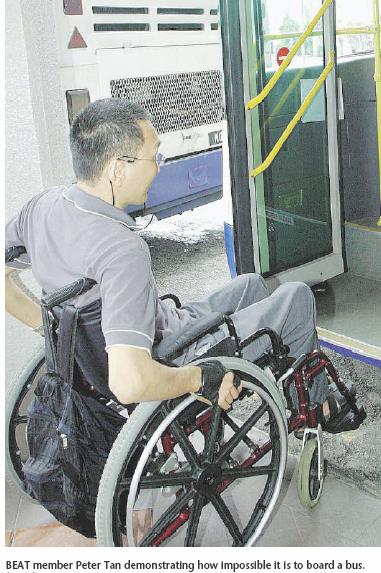
Currently, he said, the fleet of buses operated by Rangkaian Pengangkutan Integrasi Deras Sdn Bhd (RapidKL) were not disabled-friendly, thus depriving wheelchair-bound passengers or travellers on crutches to use the service.
“The steps to board these buses are high for any handicapped person. Rapid KL must ensure the handicapped too can use the public transport provided by them,” he said after an awareness campaign at the KL Sentral Station.
The campaign was held to mark the International Day of Disabled Persons aimed at promoting awareness on the need for barrier-free environment and accessible transport for all people including the disabled, senior citizens, pregnant women, adults with prams and passengers with luggage.
One of the campaign participants, Mehboob Sulaiman, 45, who was in crutches, said the public bus service provider should lower the steps leading up to the buses and ensure there was enough standing space for the disabled.
“Boarding the bus is one thing, the space inside the bus is narrow. We, the disabled, have to fight for space with the able-bodied people.
“We don’t want to inconvenience normal users but when we ourselves don’t have enough space to stand, then things become difficult.
“Sometimes, the seats for the disabled are often misused. Normal people take up the seats. We cannot ask them to vacate the seats…it is for the bus driver to ensure these seats are empty for the disabled,” she said.
Murugeswaran, who is also Damai Disabled Persons Association of Selangor and Kuala Lumpur president, said the association met officials of Rapid KL last month and handed a memorandum stating the requirements of the disabled.
“Rapid KL had made an announcement it was bringing in 1,000 new buses but these buses are not barrier-free buses.
“We are disappointed Rapid KL is not introducing non-step buses when buses of this kind are being used in many countries all over the world.
“As we move towards becoming a developed nation by 2020, the disabled do not want to be left behind,” he added.
— BERNAMA
Category: News
NST – September 25, 2006: Disabled want better access to public transport
Disabled want better access to public transport
25 Sep 2006KUALA LUMPUR: Disabled people are tired of broken promises, tired of pleading their cause and fed up that their needs are still being ignored.
Twelve years ago, the Barrier-free Environment and Accessible Transport (BEAT) group staged a protest against the Star LRT but nothing has changed.
“In 1994, a group of disabled persons staged a protest against the Star LRT for banning wheelchair users. Now, 12 years later, it is still inaccessible!
“With the exception of Putra LRT, KTM Komuter, KL Monorail, and now the newly-launched RapidKL buses, our needs have been ignored,” BEAT representative V. Murugeswaran lamented at a gathering of about 40 disabled people at the Bangsar LRT station yesterday.
They were at the launch of RapidKL’s new bus network covering Klang, Shah Alam, Subang Jaya, Damansara, Petaling Jaya and Puchong.
Murugeswaran said the disabled felt excluded from society. Most cannot work because of poor access to public transport and buildings.
“We need to go out and work and contribute to society, and not be dependent on charity,” he said.
They handed a memorandum with their wish list to Women, Family and Community Development Parliamentary Secretary Datuk Paduka Chew Mei Fun, who was on an outing with the Senior Citizens Association, Selangor and Federal Territory.
Murugeswaran pointed out that Kuala Lumpur would be hosting the 9th Fespic Games from Nov 15 till Dec 1, the biggest event for disabled athletes in Asia and Oceania.
“What kind of impression are we giving to the international disabled community if we have no proper facilities? There’s a RM10 billion allocation to upgrade the public transport system, but there’s nothing for the disabled,” he said.
A RapidKL spokesperson said the transport company had bought 100 disabled-friendly buses with ramps. These would be delivered next month.
Related entry:
Wheelchair-Unfriendly Rapid KL Buses