Redefining Disability

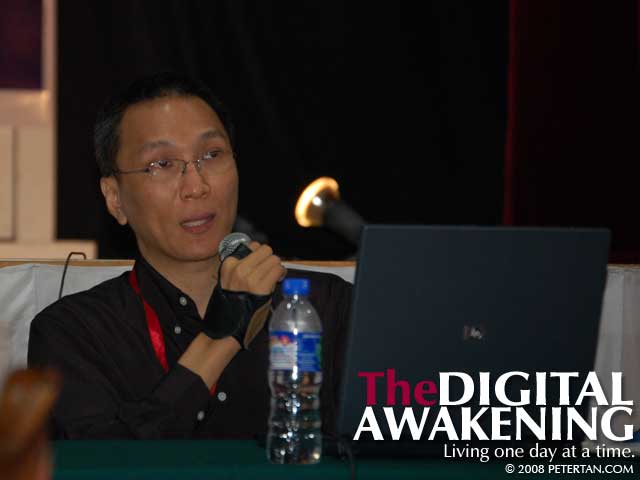
Peter Tan speaking at the 2nd Malaysian Conference on Rehabilitation.
Photo by Wuan.
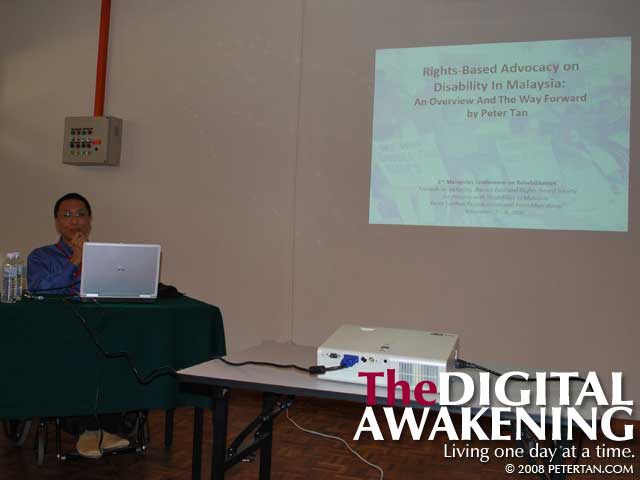
My second presentation for the 2nd Malaysian Conference on Rehabilitation at the Pusat Latihan Perindustrian dan Pemulihan Bangi (PLPP Bangi) was titled “Rights-Based Advocacy on Disability in Malaysia: An Overview and the Way Forward.” It was for the Special Interest Groups concurrent session on “Social Advocacy on Disability Issues.”
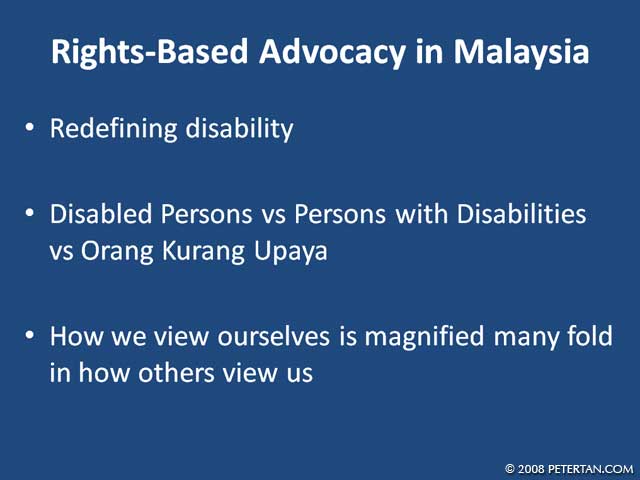
In advocating for equality, the first issue that we need to resolve is to redefine disability. I asked if disability is caused by the condition of the person or is it caused by the environment? At the same time, I challenged the use of the term “persons with disability” and its Malaysian Language equivalent “orang kurang upaya” to refer to disabled people. “Orang kurang upaya” means persons with lesser abilities. To the general public, it is just a matter of terminology but it matters a lot to me as the person who is being referred to.
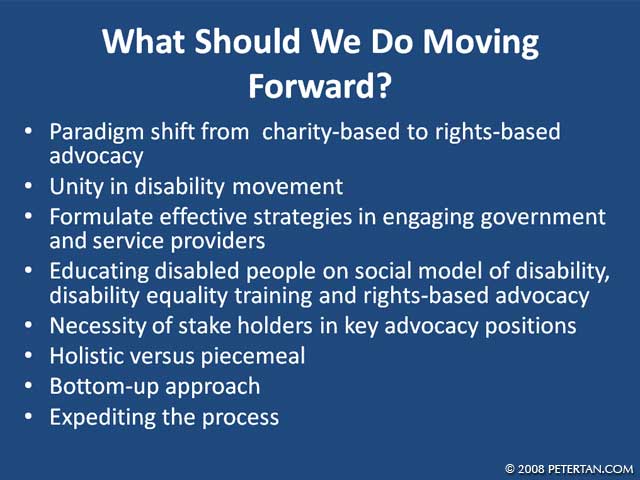
The other matters that I brought up were that there is a need for a paradigm shift from charity-based to rights-based advocacy, inclusion of disabled people as stake holder in all levels of decision making and resolving issues using a holistic approach rather than on a piecemeal basis. The following is the abstract of my presentation:
Abstract
Rights-Based Advocacy on Disability In Malaysia:
An Overview And The Way ForwardThe disability advocacy movement in Malaysia has a tattered history of modest victories and great failures. Three decades or so of advocacy and activism have not succeeded in ensuring the equalization of opportunities for disabled people. Disability is considered a problem of the minority and other people’s problems. Resolving disability-related problems are deemed extras that need money and do not benefit the majority. This essay explores the reasons behind those perceptions and how we can learn from past mistakes to effectively move the government, corporations and society to change their mindsets and create an inclusive environment that benefits everyone.
Below were the topics that my fellow speakers presented:
The Need for “Bottom-Up” Approach in the Implementation of Policies Related to Persons with Disabilities in Malaysia
Associate Professor Dr. Tiun Ling Ta
Universiti Sains Malaysia
Empowering People with Intellectual Disabilities
Ms. Khor Ai-Na
Executive Director of Asia Community Service
Media – Friend or Foe
Ms. Mary Chen
Editor, Challenges
JICA Project on Support for Persons with Disabilities in Malaysia
Mr. Hideo Tsukamoto
Assistant Resident Represnetative, JICA Malaysia
Self-Advocacy: Towards an Interdependent and Inclusive Community
Ms. Teh Hooi Ting and Ms. Yeo Swee Lan
United Voice
Promoting Accessible Public Transport – Meeting the Needs of Disabled People and All
Ms. Christine Lee
BEAT
Challenges and Success Stories of Advocacy in Diverse Communities in Sarawak
Mr. Francis Johen Adam
Tags: 2nd Malaysian Conference on Rehabilitation, disabled people Malaysia, Malaysian Council for Rehabilitation, MCR, OKU, orang kurang upaya, PLPP Bangi, Pusat Latihan Perindustrian dan Pemulihan Bangi, rights-based model on disability
Circle Of Mobility For Disabled People

Panel Discussion 2 – Barrier-Free Built-Environment and Universal Design
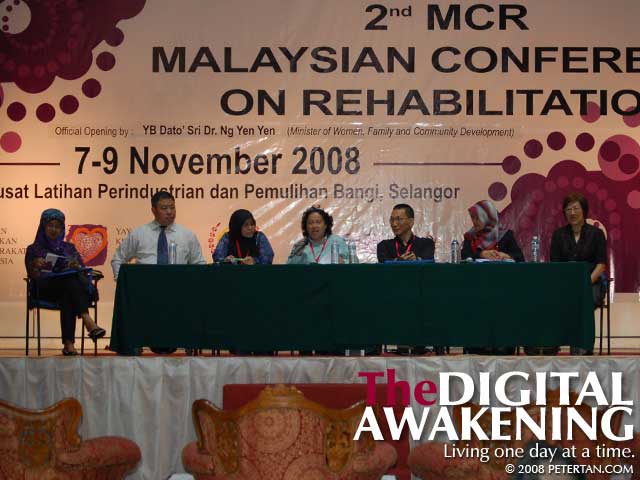
(L-R) Puan Khairiah Talha, Mr Patrick Ang, Cik Khairul Nisa bt. Haron, Cik Naziaty Yaacob (Chairperson), Peter Tan, Puan Ch’ng Gaik Bee @ Dalilah Bee Abdullah and Puan Tan Choo Lan.
Photo by Wuan.
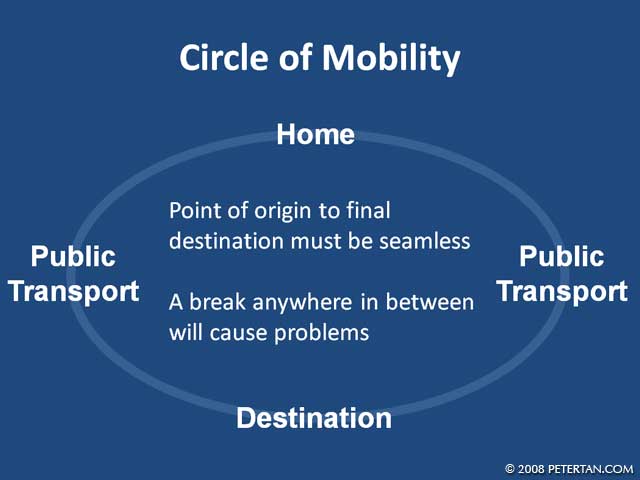
My first presentation at the panel session for special interest groups of the 2nd Malaysian Conference on Rehabilitation was titled “Inclusive Environment in Malaysia: From the Perspective of a Wheelchair User.” The main point of the entire presentation is the “Circle of Mobility for Disabled People.”

Circle of Mobility for Disabled People
The concept is very simple. The circle represents the journey from the point of origin to the destination and then from the final destination back to home. The journey includes the built environment which is represented by the line and public transport. The entire journey must be seamless. Any break in between may cause the disabled person to be stranded and unable to complete the journey.

Peter Tan speaking at the 2nd Malaysian Conference on Rehabilitation.
Photo by Wuan.
In Malaysia, the circle is broken in many places. The moment a disabled person gets out from the house, he will be faced with barriers in the built environment. These includes walkways without ramps, walkways littered with street furniture and other obstructions. Public transport is totally inaccessible. That is the reason why many wheelchair users are stuck at home and unable to go out.
The solutions are very simple actually. The government, be they federal, state or local, have the resources and means to resolve this issue. They must also take the blame for allowing this problem to fester until now. The four points for the solution that I presented were:
- Adopt Universal Design in all future infrastructural developments
- Enforce UBBL 34A and incorporate MS1331 into relevant legislation
AuditAccess officers in local governments to implement and enforce UBBL 34A- Establish a time-frame to make Malaysia accessible to all
This is the abstract for my presentation:
Abstract
Inclusive Environment In Malaysia:
From The Perspective Of A Wheelchair UserTwo important factors determine whether a disabled person becomes home-bound or live a full life outside. One is public transport, the other the built environment. One cannot exist without the other. Neither exists in Malaysia. Some may argue that parts of the built environment have become accessible in recent years. This is true to a certain extent. However, the lack of interconnectivity makes these pockets of accessible heaven another unreachable speck in the horizon for many still. There is an urgent need to impress upon the people responsible for infrastructure that an accessible environment not only provides mobility. It empowers disabled people to become independent and improves their productivity overall. Furthermore, an inclusive environment benefits everyone. What is good for disabled people is good for everyone else. This is a win-win situation for all. This paper presents my experience as a wheelchair user with examples gleaned from the Independent Living movement in Japan.
Below were the topics that my fellow panelists presented:
The Construction Industry’s Role in Facilitating for Social Inclusion
Puan Tan Choo Lan
Bahagian Kawalan Bangunan, Jabatan Kerajaan Tempatan,
Ministry of Housing and Local Government, Malaysia
Barrier-Free City Kuala Lumpur
Puan Ch’ng Gaik Bee @ Dalilah Bee Abdullah
Architect, Architect’s Department,
Kuala Lumpur City Hall
Barrier Free City Petaling Jaya
Cik Khairul Nisa bt. Haron
Assistant Director/Planner, Development Planning Department,
Petaling Jaya City Council, Selangor
Collaborating with the Local Authority in Achieving Barrier-free City, Singapore
Mr. Patrick Ang
Level Field Consultants
Singapore
Do We Need Legislative Changes Before We Care?
Puan Khairiah Talha
Secretary General, Eastern Regional Organization for Planning and Human Settlements (EAROPH)
Tags: 2nd Malaysian Conference on Rehabilitation, Malaysian Council for Rehabilitation, MCR, MS 1183, MS 1184, MS 1331, PLPP Bangi, Pusat Latihan Perindustrian dan Pemulihan Bangi, UBBL 34A, Uniform Building By-Law 34A, Universal Design
2nd Malaysian Conference On Rehabilitation
In a while, I will be going to Bangi to participate in the 2nd Malaysian Conference on Rehabilitation organised by the Malaysian Council for Rehabilitation (MCR). The conference which began yesterday is being held at Pusat Latihan Perindustrian dan Pemulihan Bangi. The theme for this conference is “Towards an Inclusive, Barrier-Free and Rights-Based Society for Persons with Disabilities in Malaysia.”
I will be speaking at the panel session on “Barrier-Free Built-Environment and Universal Design.” The topic of my presentation is “Inclusive Environment in Malaysia: From the Perspective of a Wheelchair User.” I will also be presenting at the concurrent session for special interest groups on “Social Advocacy on Disability Issues” tomorrow. My topic for the con current session is titled “Rights-Based Advocacy on Disability in Malaysia: An Overview and the Way Forward.”
Tags: 2nd Malaysian Conference on Rehabilitation, Malaysian Council for Rehabilitation, MCR, PLPP Bangi, Pusat Latihan Perindustrian dan Pemulihan Bangi, rights of disabled people, rights-based model on disability