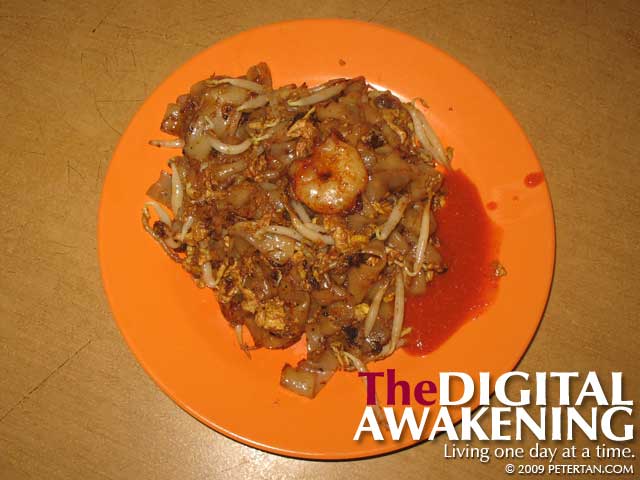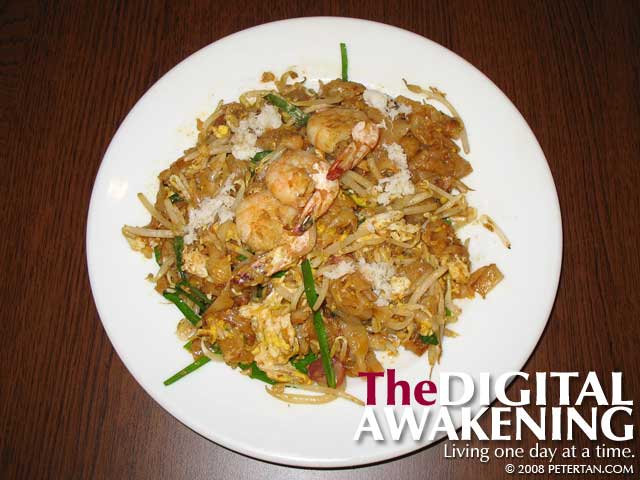
Char koay teow is an institution by itself in Penang. Every decent kopitiam, market, food court and pasar malam (night market) will have at least one stall dishing out greasy portions of this staple to diners from early morning till late night. Char koay teow stalls can easily be identified by the clanging of frying ladles against wok, the unmistakeable aroma and sometimes spicy fumes that could choke nostrils to the extent of inducing bouts of sneezing and coughing.
The basic ingredients are koay teow (flat rice flour noodles), taugeh (bean sprouts), heh (prawns), hum (cockles), koo chai (chives), lap cheong (Chinese waxed sausage), hiam cheo cheoh (chili paste) and eggs. What makes one char koay teow unique from another is the sauce and the add-ons such as crab meat, extra large prawns and mantis prawns. I must say that I am not a fan of extra large prawns in my char koay teow, preferring medium sized prawns with a generous portion of koay teow.
The hawkers have their own secret recipes for the sauce which they jealously guard from their peers. It will take more than a generous amount of money and persuasions, gentle or otherwise, to convince them to part with that secret. Apparently, from what I gathered from years of eating char koay teow, the sauce contains a blend of light soya sauce and fish sauce, among others.
Having said that, the clincher for an irresistible plate of char koay teow is, undoubtedly, how well the hawker is able to control the heat in the wok, which the Chinese calls “tiah khee” or “wok hei”, meaning “Qi of the wok”. Too much and everything in the wok becomes charred; too little will leave the dish with a “half-cooked” essence. Getting the wok to that right temperature is a skill that takes years of practice to perfect.
When I was growing up at Jalan Terengganu in Penang, I used to patronise the char koay teow hawker near the small roundabout at Caunter Hall. It was just down the road from where I lived. We all called him Ah Beng although we never knew for sure if that was his real name.
Ah Beng operated from a tricycle cart parked on the pavement. He used charcoal fire which is believed to make the koay teow more fragrant. Whenever he wanted a bigger flame he would tug on a cord to manually spin a small fan that fed more air into the mouth of the stove, and as a result stirred up sparks and embers that added more drama to his frying antics.
Those days, one could bring an egg or two from home to be added to the koay teow without extra charge even though the hawkers had eggs by the trayful at their stalls. That was exactly what I used to do then to get 20 sen off for a plate of Ah Beng’s char koay teow. Try that now and the hawkers would give you dirty looks and may even refuse to serve you.
I have never had a liking for cockles and chives. My usual order would be “mai hum mai koo chai”. And Ah Beng was always generous with bak eu pok (crispy pork lard) which made it even more palatable. There was little space to sit and enjoy his char koay teow where he plied his trade. I usually ordered take away. He would wrap them in used newspaper lined with a piece of banana leaf.
It has been more than two decades since I last had a taste of Ah Beng’s char koay teow. One day, he just did not open for business. Rumour swirled around on the reasons of his sudden disappearance. I was more concerned with not being able to get char koay teow that I grew up eating anymore. I have since moved on to appreciate char koay teow from other stalls. Like they say, the first is the best. No other char koay teow in Penang can quite compare to Ah Beng’s charcoal fired char koay teow stirred in with an egg brought from home. That was simply delicious beyond words.