petertan.com icon

Tag Archive

Prasarana And Its Disabling Assets

September 22nd, 2008 - Monday

There are two things that disable people. One is attitude, the other is the environment. Of the two, attitude is the most difficult to change yet is the easiest to do. All that is needed is to understand the Social Model of Disability. Nevertheless, people still have the perception that people are disabled by their conditions and therefore are to be blamed if they cannot use public amenities. Furthermore, facilities suited for use by disabled people are often delegated to the lowest of priorities because disabled people are not considered productive citizens worthy of the money spent.

Is it that difficult to see that what is good for disabled people is good for everyone else? Countries like Japan and Australia have already adopted inclusive policies that require that public amenities are accessible to everyone. It was in Tokyo that I experienced real liberation as a wheelchair user for the first time. If that can be done in Japan why then can it not be done here in the spirit of Malaysia Boleh?

Apparently people who are in position to change things are not interested to make Malaysia an inclusive society. They prefer to cling on to their prejudices and cocoon themselves in their own comfort zone. They refuse to lift a finger to improve the situation but prefer to turn a blind eye to the fact that disabled people are in Malaysia are so marginalized that many are living in conditions of abject poverty.

Now I begin to understand why the advocacy for accessible public transport in Malaysia has not moved forward as fast as I had expected. It was naive on my part to think that the situation can be easily resolved by writing a few letters to the authorities concerned and meet with ministers to lay out the problems to them.

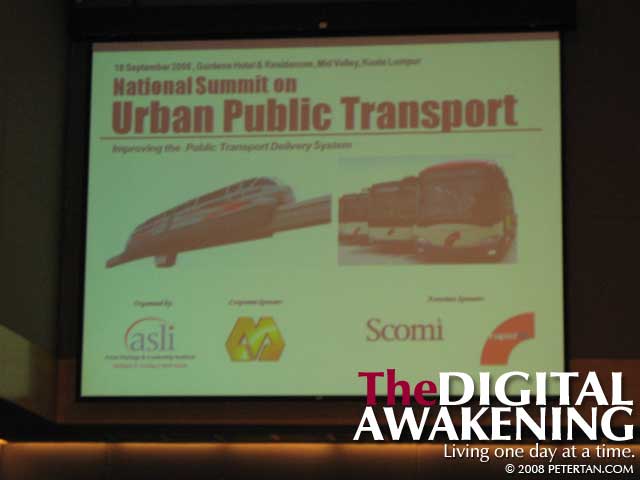
National Summit on Urban Public Transport

I discovered this sad fact at the National Summit on Urban Public Transport organised by Asian Strategy and Leadership Institute (ASLI) at The Gardens Hotel and Residences last Thursday. Datuk Ong Tee Keat officiated the summit. In his keynote address he said the following among others:

It is also essential to highlight, that a public transport is not an exclusive domain of sections of the population, but must cater for all. The disabled community is an integral part of our communities and I do urge that their needs must be integrated in our public transport planning.

Although I have an inherent mistrust of politicians delivering well crafted speech and not fulfilling it afterwards, I am going to give Datuk Ong the benefit of the doubt and welcome this statement. I believe that he is serious in resolving the transportation woes of disabled people. The only ironic thing about this entire matter is that the Minister of Transport does not have full control over the regulation of public transport in Malaysia. It is being jointly regulated by thirteen agencies with some having overlapping jurisdiction over another.

My main purpose in attending the summit was to see what is being done to make public transport accessible. When Syarikat Prasarana Negara Berhad (Prasarana) Chief Executive Officer Shaipudin Shah Harun spoke during the panel session titled “Towards an Efficient Urban Public Transport System,” I was all ears.

Prasarana is the asset owner of RapidKL. It owns all the RapidKL and Rapid Penang buses, Kelana Jaya Line and Ampang Line light rail transit networks, KL Monorail and the Langkawi Cable Car System. Prasarana in turn is a wholly-owned government company under the Ministry of Finance Inc.

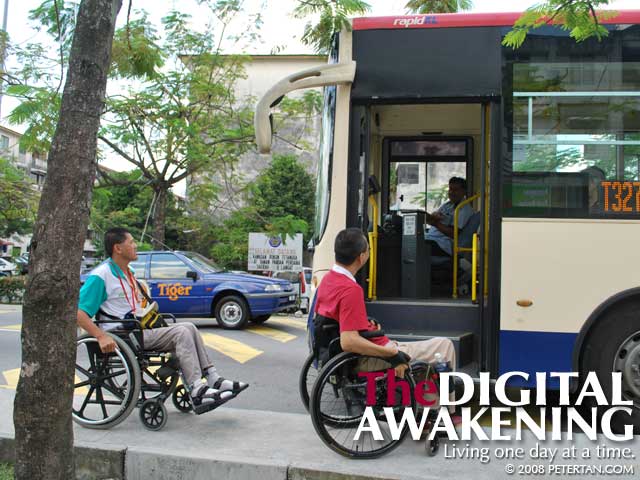
RapidKL bus at Pandan Perdana
Photo by Wuan.

At the Q&A session afterwards, I asked the following:

When we talk about public transport, why are disabled people left out of the equation? Is Prasarana going to buy non-step buses from now on or continue to put buses with steps on the road?

Below are Shaipudin’s response transcribed from the video recorded by fellow participant Naziaty Yaacob:

The issues of building structures. What good would it do for you to be able to get up a bus which is low floor and then you have pavements which are uneven with manholes uncovered.

The country as a whole must have what you call a real policy on the issue of the OKU.

We try our best. As for the same question, for all the new facilities that we are putting up, the trains and all that, for the new lines, the extension lines, all the needs of the OKUs are being registered and will be taken for but as I said there will not be the end to the answer to your problem.

What happens when you leave our stations? Are the streets friendly enough for you?

This is not a Prasarana question question alone.

The problem here is not only faced by OKU. Even the able people too are having problems. How many walkways do you see along the streets which enable us to walk conveniently?

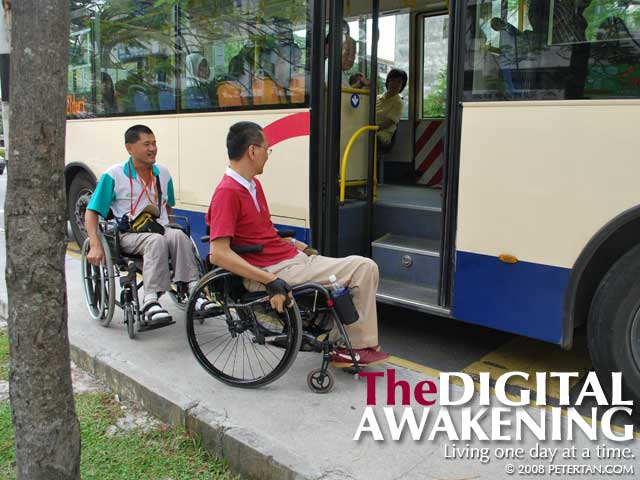
RapidKL bus at Pandan Perdana
Photo by Wuan.

My question to Prasarana was actually very straightforward. A simple “yes” or “no” would have sufficed. Instead, Shaipudin gave a discourse on the inaccessible built environment. I do not disagree with his view that disabled people may face problems after getting off the buses. Nevertheless, Prasarana should just concentrate in ensuring that all its buses, trains and terminals are fully accessible. The municipals councils are the parties responsible for the built environment other than those owned by Prasarana and that matter should be left to these municipalities to resolve. If Prasarana is going to wait until the built environment is fully accessible before they change the entire fleet to non-step buses, disabled people may have to wait another ten years or even longer to be able to use public transport.

Shaipudin also argued that non-disabled people are also facing problems with the built environment. It is true that non-disabled people encounter such problems too but that does not usually prevent them from getting to the bus stop to catch a bus. Additionally, it does not take long to add ramps to existing walkways. The 500 meter stretch in Pandan Perdana including the bus stop, although not built to specifications, was made accessible in a period of less than one month.

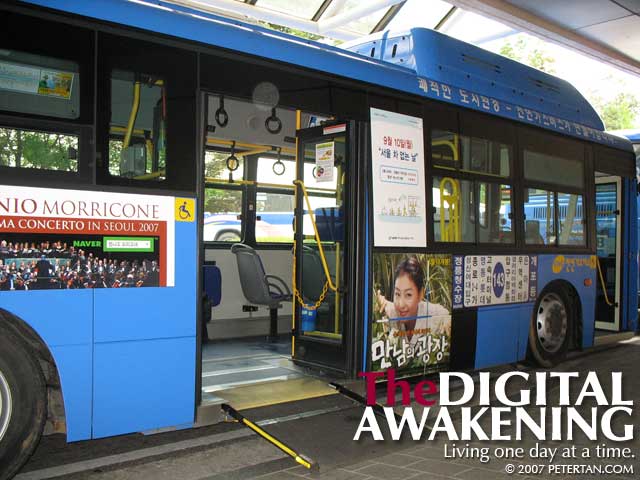
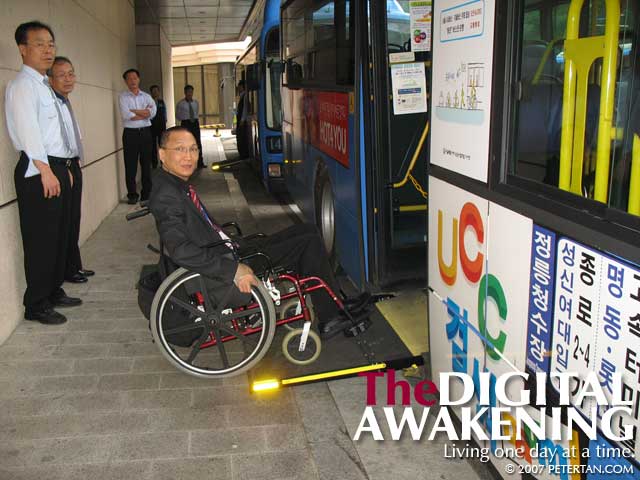
Non-step bus with the ramp deployed
Non-step bus with the ramp deployed in Seoul, Korea.

Truth be told, I am ignorant of the lifepspan of RapidKL’s buses. Lets guesstimate that these buses are phased out after ten years of service. If the municipal councils are able to make most of the bus stops accessible within two years from now, that means disabled people have to wait at least five more years for the current buses to be replaced with non-step ones. And if Prasarana continues to put new buses with steps into service, how long more before disabled people can ride in public buses?

Prasarana as the asset owners with its hardware paid for from the people’s money via the Ministry of Finance Inc. must ensure that all buses purchased in the future must be accessible to everyone. Non-step buses are most suitable for this purpose. Such buses are widely available and used in major cities in the Asia Pacific countries like Japan, Korea and Australia. These buses are not only convenient for wheelchair users but for senior citizens and people with mobility impairments, pregnant women and children. What is good for disabled people is good for everyone else.

Wheelchair user boarding the non-step bus
Boarding the non-step bus in my wheelchair in Seoul, Korea.

What I cannot understand is Prasarana’s reluctance in making all their new buses accessible. Is Prasarana going to lose anything by including the transportation needs of disabled people? Everybody benefits if these buses are accessible. The Minister of Transport has already acknowledged that disabled people are an integral of the community. Why then is Prasarana continuing with its disabling policy that marginalizes disabled people?

Without access to public transport, disabled people are unable to achieve a reasonable quality of life. We are unable to go to schools and go to work. We are unable to participate in social, cultural, religious and political activities. Prasarana’s is attitude in this issue is most baffling. It has failed in the task entrusted to it by the government to provide the assets to RapidKL and Rapid Penang to run a public transport service to benefit everyone.

Tags: , , , , , , , , , , , , ,

RapidKL And RapidPenang - Will Disabled Persons In Malaysia Ever Get To Ride in Public Buses?

August 10th, 2007 - Friday

Najib also said that the Transport Ministry was taking steps to address complaints by the disabled community that RapidKL and Rapid Penang buses were not disabled-friendly despite their earlier appeals.

The Star - Thursday August 9, 2007: New, bigger LCCT to be built

Deputy Prime Minister Datuk Seri Najib Tun Razak’s statement concerning RapidKL and RapidPenang is most welcomed. However, nasi sudah jadi bubur. It is good if the Ministry of Transport make good the statement by Dato’ Seri Najib but I should not be faulted for being cynical. Despite assurances by Second Finance Minister Tan Sri Nor Mohamed Yakcop in the press on March 18, 2007 that RapidPenang’s buses will be “disabled friendly” none were. On top of that RapidKL Chief Operating Officer Mohd. Ali Mohd. Nor informed the Barrier-Free Environment and Accessible Transport Group (BEAT) during a meeting on March 10 that the 150 buses for RapidPenang would be accessible to wheelchair users which obviously was misleading.

Retrofiting the buses already running on the roads in Penang is going to cost a lot more as compared to bringing in non-step buses in the beginning. The reason for not acquiring non-step buses for RapidPenang was given by Penang State Traffic Management Committee Chairman Dato’ Dr. Teng Hock Nan on April 26. He was reported by The Star in Buses for disabled later to have said, “The state government will bring in buses equipped with facilities for wheelchair passengers once the new RapidPenang bus system is running smoothly” because “buses with facilities for wheelchair passengers would have to stop longer for boarding and could disrupt arrival schedules.” I wrote an entry to rebut his baseless and discriminatory statement.

As for RapidKL, 100 non-step buses that they brought in were fitted with ramps and wheelchair docking systems without consultation with disabled persons on whether the fittings would be functional and safe. When BEAT viewed the buses for the first time after they were fitted, we informed Mohd. Ali Mohd. Nor that the ramps were too short and were poorly designed. In later meetings with RapidKL Corporate Communications Division Senior Manager Katherine Chew we were told that the fittings were of international standards. When questioned further what international standards were used, we were told on one occasion that it was the Swedish standards and another occasion the Australian standards. Whatever standards that were used, they certainly did not meet Malaysian disabled persons’ standards as the ramps and docking systems were neither safe nor functional. The accessible buses were to be launched on June 1 has been postponed indefinitely because of those concerns raised by BEAT.

In a meeting on May 25 chaired by the Timbalan Ketua Setiausaha (Perancangan) Kementerian Pengangkutan Malaysia Datuk Long See Wool regarding accessibility in public transport initiated by Minister of Transport Dato’ Seri Chan Kong Choy, BEAT was informed that RapidKL buses do not come under the Ministry of Transport. The Ministry of Entrepreneur and Co-operative Development are responsible for issuing licenses to buses and taxis. Therefore Datuk Seri Najib’s statement that “the Transport Ministry was taking steps to address complaints by the disabled community that RapidKL and Rapid Penang buses were not disabled-friendly despite their earlier appeals” came as a surprise. Which ministry exactly is in-charge of RapidKL? I would also like to know what steps the Ministry of Transport are taking to enable disabled persons, especially wheelchair users, to use public transport. Why was this issue not addressed at the planning stages of RapidPenang especially when BEAT had already handed a recommendation to Dato’ Seri Chan Kong Choy on March 12? The following is an extract from the recommendation:

Pengangkutan Awam Di Pulau Pinang
BEAT mengalu-alukan pengumuman oleh Perdana Menteri pada 20 Februari 2007 bahawa Rapid KL akan menubuhkan satu rangakaian bas awam di Pulau Pinang yang diberi nama RapidPenang. Kami berharap RapidPenang tidak membuat kesilapan sama seperti di Lembah Klang di mana keseluruhan perkhidmatan bas awam adalah tidak mudahcapai dan tidak mesra OKU.

Kami berharap Kementerian Pengangkutan bekerjasama dengan Kementerian Kewangan dan mana-mana kementerian lain yang berkenaan untuk mendapatkan bas non-step untuk kesemua 150 buah bas yang dibeli kelak. Golongan OKU tidak seharusnya menderita disebabkan oleh kesilapan sesetengah pihak yang tidak mengambil kira keperluan OKU dan mereka yang mengalami kesulitan pergerakan yang ingin menggunakan perkhidmatan bas awam.

Pada masa yang sama, rancangan rel bandaraya Pulau Pinang yang telah diluluskan mesti mudahcapai kesuluruhannya apabila beroperasi nanti. Tidak ada sebab yang munasabah mengapa golongan OKU disisihkan lagi dalam projek ini yang sepatutnya memanfaatkan semua lapisan masyarakat.

Dalam pada itu, kami menyeru Kementerian Pengangkutan, Kementerian Kewangan, Rapid KL, RapidPenang dan mana-mana pihak yang mewakili pengurusan projek tersebut untuk berbincang dengan pihak-pihak yang mempunyai kepentingan (stakeholders) dalam perkhidmatan bas awam di Pulau Pinang, khususnya pengguna-pengguna bas dan pertubuhan-pertubuhan OKU untuk menyelami keperluan mereka serta mendapatkan maklumbalas dan keperluan mereka dalam pembangunan yang terbaru ini.

I rest my case.

Tags: , , , ,

Monster Blog - April 6, 2007: RapidPenang Ignores The Transportation Needs Of Disabled Persons

April 7th, 2007 - Saturday

RapidPenang Ignores The Transportation Needs Of Disabled Persons

The report that RapidPenang will not be bringing in buses accessible to wheelchairs is disappointing news (The Star - April 4, 2006: Courtesy classes for Penang bus drivers). The statement by Datuk Dr. Teng Hock Nan is a step backward for Malaysia in respecting the rights of disabled persons in the area of transportation and mobility.

The statement that wheelchair users need special buses is not only incorrect but misleading as well. In the Asia-Pacific accessible buses are already widely used in Japan and Australia to serve not only wheelchair users but the general public. These non-step buses are also convenient for senior citizens, pregnant women and adults with prams as the floor of the buses are flushed with the height of the bus stops.

Dr. Teng’s statement is also in contradiction to Minister of Transport Dato’ Seri Chan Kong Choy’s announcement that the transport needs and interests of disabled persons will be included in the Public Transport Master Plan (NST - March 13, 2007: Master plan to help disabled move about). Second Finance Minister Tan Sri Nor Mohamed Yakcop was also reported to have announced that the buses will be disabled-friendly (The Star - Getting feedback on RapidPenang, March 19, 2007).

In meetings with officials from Rapid KL, representatives from the Barrier-Free Environment and Accessible Transport Group (BEAT) have been asked to be patient and told that things cannot change overnight. BEAT was also reassured that all buses acquired by Rapid KL in the future will be accessible to disabled persons, especially to wheelchair users. BEAT is a coalition of 16 NGOs of disabled persons.

During BEAT’s latest dialogue with Rapid KL in March, Chief Operating Officer Mohd. Ali Mohd. Nor said that RapidPenang will acquire 120 accessible buses. Now we hear that such buses will not be brought in. After this about turn, disabled persons will find it extremely difficult to believe that the government is really serious and sincere in addressing our transportation needs. While we accept that things cannot change overnight, we are aghast that things are not moving forward but backward instead.

This is another apparent instance of intentionally marginalising disabled persons from mainstream society. Our needs should not be seen as separate and different from non-disabled persons. We have every right to use public transport as everyone else. We have been excluded from society for far too long. Mobility is an urgent need of disabled persons, especially wheelchair users. Without accessible public transport, we are left out from educational and employment opportunities. We are also unable to participate meaningfully in social, cultural, religious and political activities because of the inability to move around conveniently.

On behalf of my peers, I appeal to Rapid Penang, Syarikat Prasarana Negara Berhad and the Ministry of Finance to reconsider the decision to not acquire accessible buses. Such buses will benefit everyone. Do not make the same mistake that Rapid KL made in disregarding the needs of disabled persons. There should be no excuse now especially when the government is already made aware of such needs and have promised to solve it. Apa macam Malaysia?

—–

N E W S

North
Monday March 19, 2007

Getting feedback on RapidPenang

By V. CHANDRASEKARAN

PENANG will set up a public transportation advisory panel soon to assess and gather feedback on RapidPenang and the proposed monorail system.

Chief Minister Tan Sri Dr Koh Tsu Koon said the panel would comprise representatives from non-governmental organisations (NGOs) and the state government.

“The state will brief the panel, starting off with RapidPenang. We want the system to fulfil the people’s needs,” he said.

The state would provide concessions to senior citizens, students and the disabled, he told reporters after attending a meeting with Second Finance Minister Tan Sri Nor Mohamed Yakcop here yesterday.

RapidPenang, expected to start operations in August, is a subsidiary of RapidKL that is owned by Syarikat Prasarana Negara Bhd.

Nor Mohamed said 80 buses would ply the main roads while 40 would serve feeder roads and 30 would provide services in villages.

The buses would be disabled-friendly, he said, adding that 267 workers would be employed and the fare affordable.

The existing bus companies would continue to carry on as usual, he said.

He said the new public transport system would cost R51mil – RM31mil to buy buses while the rest as working capital for five years.

He said two RapidKL buses were now in Penang to test out the routes.

Citizens for Public Transport (Cepat) coordinator Dr Choong Sim Poey said Cepat had been pressing for the setting up of an advisory panel to voice out views and complaints from the public over the public transportation system.

“I am glad the state has responded positively. We will see whether we are invited,” he said.

Tags: , , , , , ,


Top Tags